Stories of Transformation

Nurturing agency: How participatory research and action are expanding possibilities for school girls from ethnic minority communities in Vietnam’s Lao Cai province

Nurturing agency: How participatory research and action are expanding possibilities for school girls from ethnic minority communities in Vietnam’s Lao Cai province lorem ipsum

Country

Vietnam

Action research in Lao Cai highlighted an important insight: ethnic minority girls already have agency and thrive in supportive and responsive ecosystems. Families, schools, and communities are strengthening environments that foster and sustain it.

Context of Lao Cai

In the mountainous Lao Cai province in Vietnam, where 27 ethnic minority groups live across  remote and often challenging terrain, girls grow up surrounded by rich cultural traditions as well as complex realities. For many, the path to adulthood involves navigating a range of barriers including early marriage, school discontinuation, and limited livelihood opportunities. Compared to men, ethnic minority women are more likely to leave school earlier and may have fewer opportunities to access stable income, assets or participation in  decisions affecting their own lives.

Collaborative research and action with LAAGA

Tran Thi Ngoc Tran has been working at the intersection of entrepreneurship, education and development practice, dedicated to supporting disadvantaged communities to fully participate in society. Her interest in using participatory research and action as an approach to strengthen the inclusive ecosystem for girls from disadvantaged communities motivated her to join LAAGA in 2022. In March 2023, Tran, in collaboration with the faculty at the Vietnam Women’s Academy, led an action research project, with adolescent girls in two schools in Muong Khuong, the district with the highest poverty level in the Lao Cai province. The research sought to understand what agency means for girls and how families, schools, communities and other stakeholders in the ecosystem can better support  it. Through reflection and participatory engagement, girls articulated their understanding of agency, what it means to them and how they exercise it, describing it as a dynamic and relational process shaped by confidence, support from others, and their ability to navigate everyday decisions within their social contexts. 

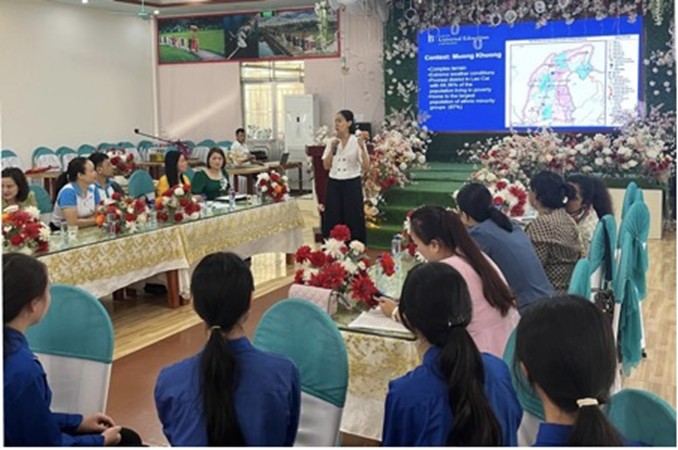
The research findings were shared through a series of inter-generational community dialogues and meetings across Muong Khuong, Hanoi, and Can Tho. The community dialogues engaged nearly 100 participants: girls, parents, teachers, school leaders, and district officials. The roundtable in Muong Khuong brought girls face-to-face with the very adults – parents, teachers, local officials – who shape their daily realities. Together participants reflected on  the research findings, discussed key challenges, and considered practical ways forward. Findings were also shared with local authorities and national level partners and institutions including the Vietnam Women’s Union in Can Tho, Irish Aid, and UN Women.
“Working alongside girls, we saw that agency is already there. Our role is to nurture it in ways that reflect their needs, perspectives, and lived realities, strengthen it over time, and ensure the environments around them allow it to grow”

Tran Thi Ngoc Tran

Vector (10)

What is changing

The dialogues generated interest from the community and schools to apply the research findings to concrete action. Building on this momentum, and with endorsement from local authorities, the Change Champions Clubs, implemented within an existing national program framework, offered a practical platform to launch a follow-on catalytic initiative. 

This initiative aims to deepen understanding of how education can nurture girls’ agency in marginalized contexts, while informing its integration into national programs. It focuses on strengthening inner courage, analytical thinking, the ability to engage support networks, and the confidence to shape one’s own future.

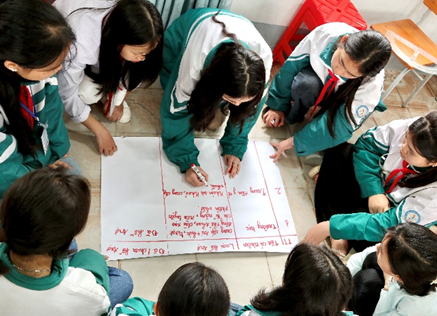
Co-designed with girls and grounded in the lived realities of ethnic minority communities, the program is organized around two complementary learning strands. The first supports girls to challenge limiting beliefs and approach decisions with curiosity and reasoning. The second strengthens their capacity to identify and mobilize support systems, learn from role models, and navigate challenges. Sessions combine reflection, dialogue, and participatory activities, with flexibility to adapt to different contexts. The “Dear Me” letter-writing activity deepens this process by enabling girls to reflect on their experiences, clarify aspirations, and commit to concrete actions, reinforcing both self-awareness and intentionality.

Using a participatory approach, the program engages school leaders, teachers, and parents alongside girls. Through Training of Trainers, girls develop facilitation skills and lead peer learning within the Change Champions Clubs, strengthening their agency.

Implementation showed that agency is built through everyday actions. Girls reported greater confidence in expressing their views, supporting peers, and navigating challenges. School leaders committed to integrating the program into annual plans, while teachers showed greater willingness to facilitate open conversations with girls and parents, and expressed interest in additional modules and cross-regional exchange. Parents also engaged more deeply; one mother, after reading her daughter’s letter, reflected on her role in supporting her child’s confidence. Girls described more meaningful family conversations, greater peer support, and aspirations to connect with young leaders beyond their district. Local authorities signaled commitment to sustain the clubs and expand the model.

Finally, and importantly, the project sowed the seeds of building a shared understanding of girls’ agency. Teachers, parents, community leaders, and girls themselves are increasingly recognizing that agency is not an individual outcome – it is a collective responsibility, built through supportive relationships and structures. This cohesion is a key ingredient to sustain the capacity and commitment going forward.

Next steps

As the national program continues through 2026–2030, it provides a foundation to further strengthen implementation and, building on early results, can support more consistent integration of girls’ agency in practice.


This story was collected in a conversation with Tran Thi Ngoc Tran, Country Coordinator for Vietnam – Education Development Center, Member of Learning and Action Alliance for Girls’ Agency (LAAGA), 2021 Echidna Global Scholar – Brookings Institution

Group 8124
Group 8069 (2)

About LAAGA

The Learning and Action Alliance for Girls’ Agency (LAAGA) is a community of practice composed of 23 leaders from 18 countries across Africa, America, Asia, and the Middle East (all of them Echidna Global Scholar alumni) and the Brookings Center for Universal Education team focused on gender equality in and through education.

Good to see you again!

New here? Join KDN

Group 8069
Group 8069 (1)

Join our monthly newsletter