Stories of Transformation > Red Educativa Perú

From Research to Root Causes: How Evidence Shifted the Ground Beneath Student Voice

How Red Educativa Perú used collaborative research and action in Ascope and San Marcos to create lasting conditions for student participation.

KDN Member Since

2021

Organization

Red Educativa Perú

Country

Peru

In Malawi, the numbers tell a challenging story. Eighty-six percent of young people of secondary school age have no access to education at all. Of those who do make it through primary school, fewer than thirty percent proceed to public secondary education — and just four percent of secondary graduates ever reach tertiary study.

Vision, Mission & the Challenges We Set Out to Address

Red Educativa Perú works toward an education system where every child — regardless of geography or background — is not only enrolled in school, but actively heard within it. Our mission is to strengthen the capacities of local education actors to generate and use evidence for equitable change.
In the provinces of Ascope and San Marcos, two challenges defined our starting point:

  1. Invisible Student Voice

Despite existing student council structures, decisions about school life were consistently made without meaningful input from students themselves.

  1. Absent Evidence

Education authorities had no local data on the degree to which students participated in governance — making it impossible to advocate for change.

The CUE collaboration gave us something rare — permission to slow down and understand before we acted. That patience is what made the outcomes durable.

- Director, Red Educativa Perú

Vector (10)

What Made the Partnership Transformative

Our collaboration with the Center for Universal Education brought two things we could not have built alone:

  1. Research Capacity Strengthening
     CUE’s participatory research frameworks gave our team the tools to design and lead rigorous, locally-grounded studies with youth as co-researchers.
  2. Peer Learning Across Contexts
    Learning exchanges with partner organizations in Colombia and Jordan surfaced approaches we had not considered, accelerating our design cycle by months.

The CUE collaboration gave us something rare — permission to slow down and understand before we acted. That patience is what made the outcomes durable. Test

- Director, Red Educativa Perú

Vector (10)

What the Research and Action Produced

Across both research sites, the collaborative process generated tangible results at multiple levels:

  1. Capacity
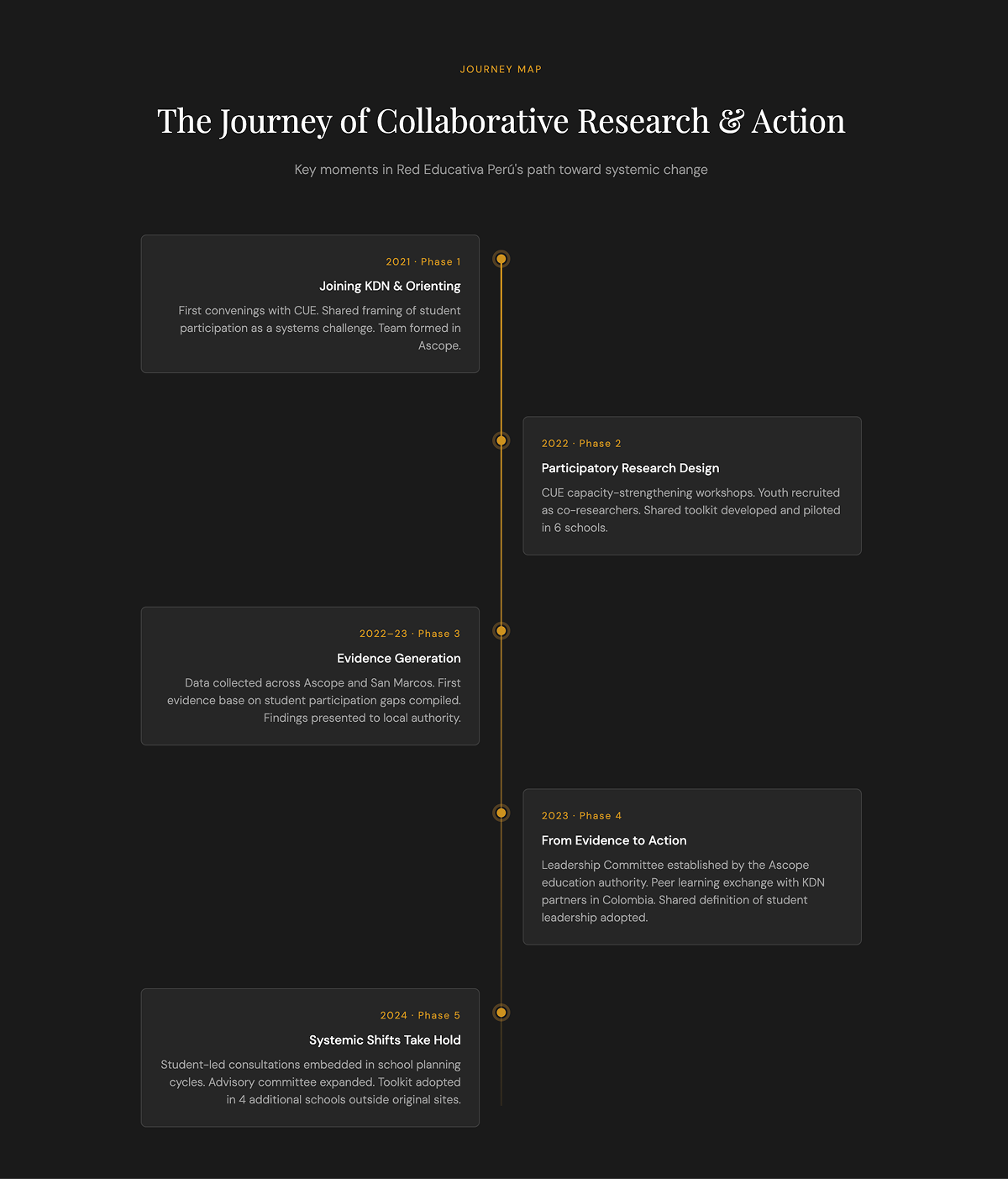
    A new cross-school research team of 12 educators and 8 youth researchers was established, with a shared toolkit for participatory data collection that has since been adopted in 4 additional schools.
  2. Commitment
    The local education authority in Ascope established a Leadership Committee specifically tasked with reviewing evidence on student participation and proposing policy responses — the first such body in the province.
  3. Cohesion
    For the first time, school directors, teachers, parents, and students across both provinces agreed on a shared definition of student leadership — creating a common language for advocacy and accountability.

Lorepm ipsum 1

ipsum 1

Vector (10)

Shifts We Have Witnessed

Shifts We Have Witnessed

  1. Practices
    Top-down agenda-setting in school councils
    Student-led consultations now precede major school decisions
  2. Relationships
    Transactional parent-school interactions
    Joint parent-teacher-student working groups in both provinces
  3. Mindsets
    Students seen as recipients of education decisions
    Students recognized as co-designers of school culture
  4. Power Dynamics
    Evidence generated by external experts
    Local actors hold, own and use their own evidence

Lorem ipsum 2

ipsum 2

Vector (10)
Group 8124
Group 8069 (2)

Future Actions

Taking This Work Forward. The evidence is there. The relationships are built. The next step is to bring this work to scale — not by replicating a model, but by equipping more local actors to lead their own version of it.

  1. Regional Expansion of Participatory Research

We will facilitate a co-design process with three additional provinces to adapt the toolkit and youth co-researcher approach, targeting at least 15 new schools by 2026.

Good to see you again!

New here? Join KDN

Group 8069
Group 8069 (1)

Join our monthly newsletter